The Moment Everything Split Apart
We are living through a regulatory inflection point that will shape AI development for a decade. In August 2025, the European Union’s AI Act moved from theoretical framework to operational enforcement. At the same time, the Trump administration issued an executive order in January 2025 rescinding Biden-era AI safety directives and explicitly signaling that U.S. policy would prioritize deployment speed over precautionary guardrails. These two decisions did not just create different rule sets. They created fundamentally incompatible governing philosophies operating on the same global technology infrastructure.
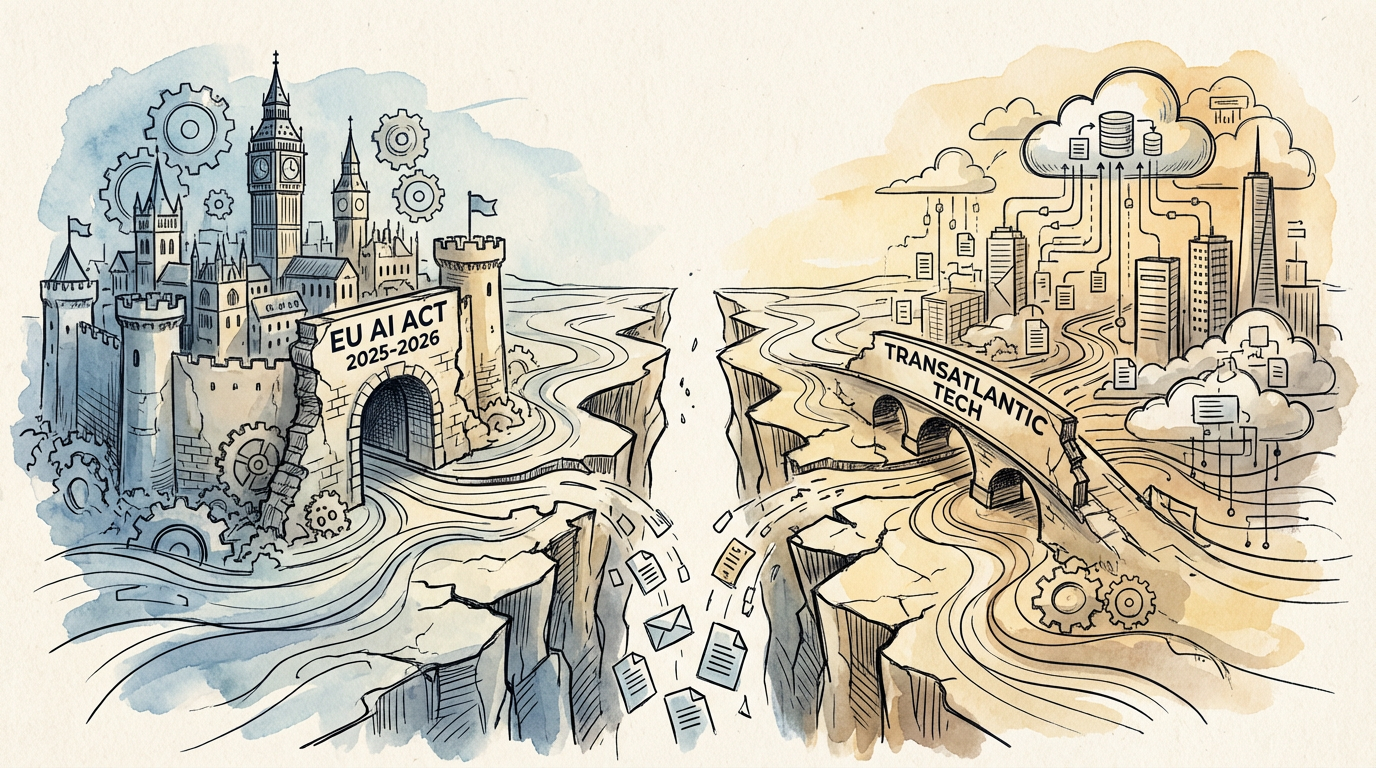
The divergence is not subtle policy drift. It is structural. The EU’s high-risk AI systems regime now carries penalties reaching €35 million or 7% of global annual turnover, whichever figure is larger. The U.S. has moved in the opposite direction, with federal guidance now explicitly pushing agencies to enable rather than constrain AI development. This is not a disagreement about implementation details. This is a collision between two competing theories of how to manage transformative technology.

What the Companies Are Actually Doing
Major AI developers have responded with a two-faced strategy that reveals just how serious the divergence has become. OpenAI, Google DeepMind, and Meta all submitted compliance documentation to the EU AI Office during the third quarter of 2025, acknowledging the binding nature of European standards. These same companies have simultaneously been lobbying the U.S. Commerce Department to resist adopting equivalent standards. This is not opportunism. This is rational economic behavior in response to regulatory fragmentation.
The Stanford HAI policy team released a detailed analysis in October 2025 quantifying what this double compliance actually costs. Multinational AI developers now face approximately €4.2 billion in annual compliance expenses stemming entirely from regulatory divergence between the EU and U.S. frameworks. These costs do not produce innovation. They do not accelerate beneficial AI deployment. They exist purely because two major jurisdictions have chosen incompatible governance paths. For companies operating in both markets simultaneously, this is not a minor compliance burden. It is a structural competitive disadvantage.
The Three-Way Fragmentation Nobody Expected
Here is where the analysis gets genuinely complicated. The EU-U.S. split is bad enough, but China has not been idle. The Cyberspace Administration finalized its second round of generative AI regulations in mid-2025, creating a third distinct regulatory ecosystem. The OECD, in its most recent assessment, described this three-way fragmentation as the most consequential splintering of technology governance norms since GDPR restructured data protection law globally.
These are not overlapping standards with minor variations. These are three different models for what AI governance should accomplish. The EU emphasizes precaution and rights protection. The U.S. is now explicitly prioritizing development velocity and market competition. China is prioritizing state capacity and information control. A single large language model or training dataset cannot easily comply with all three simultaneously. Developers must effectively maintain three different versions of core systems, or make strategic choices about which markets to prioritize.
The irony is worth noting. GDPR created regulatory pressure that ultimately produced a global floor for data protection standards. Everyone eventually aligned toward European requirements because that was the strictest regime. This new AI fragmentation is different. There is no single strictest standard everyone will simply adopt. Instead, we have three powerful jurisdictions with genuinely incompatible requirements and no obvious pressure point driving convergence.
Why This Matters Beyond Silicon Valley
The practical implications extend far beyond corporate compliance costs. EU AI Act official text and implementation timeline shows that regulatory enforcement is already underway, with the EU AI Office conducting audits of major model providers. Smaller AI companies and startups face a particular squeeze. They lack the compliance infrastructure and legal resources of companies like OpenAI or Meta. Many will simply choose not to operate in certain markets. This regulatory fragmentation thus becomes a competitive moat for large corporations that can afford parallel compliance systems.
The innovation implications are also worth taking seriously. Research teams trying to develop AI systems that work across borders now face genuine technical constraints. Certain safety testing procedures required under the EU framework are incompatible with U.S. requirements prioritizing rapid iteration. Certain data practices permitted in the U.S. market are prohibited in Europe. This is not merely different oversight. This is different underlying technical architecture. The cost of maintaining multiple codebases is not just financial, it is cognitive and developmental. Teams cannot focus entirely on advancing the technology. They must divide attention across maintaining regulatory compliance in parallel systems.
The Questions Nobody Has Good Answers For
Here is what we actually do not know. We do not know whether this fragmentation will eventually drive convergence pressure or entrench deeper divisions. GDPR eventually became a global de facto standard because strict European requirements incentivized compliance everywhere. But AI governance differs in critical ways. The financial stakes are higher. The strategic interests for each jurisdiction are more explicit. The technical requirements are more fundamentally incompatible.
We also do not know whether this fragmentation will slow AI development or accelerate it. The EU governance model may impose real constraints on beneficial research. The U.S. emphasis on deployment velocity may produce unsafe systems that undermine public trust across all markets. Or the regulatory pressure might be meaningfully mismatched to actual risks in ways that neither side recognizes yet. These are empirical questions that will only become visible over several years as implementation proceeds. What we can observe right now is that the divergence exists, it is intentional, and it reflects genuine disagreement about what responsible AI governance should prioritize.
This fragmentation is not a temporary negotiating position. It reflects structural differences in how the EU and U.S. regulate technology generally. The 2025-2026 period matters precisely because compliance is moving from theoretical to operational. Companies are not preparing to comply. They are actively complying. Regulators are not planning enforcement. They are enforcing right now. For deeper analysis of how different governance models are evolving, Stanford HAI AI Index and policy briefs provide detailed technical tracking. The question now is not whether fragmentation exists. The question is what political or market pressures might eventually force convergence, and whether either approach will ultimately prove sustainable.