When Advisory Opinions Aren’t Actually Advisory
The International Court of Justice doesn’t issue idle pronouncements. When it released its advisory opinion in July 2024 addressing the legal consequences of Israeli occupation in Palestinian territories, it marked the first time the court had directly assessed the occupation’s lawfulness since its establishment in 1945. This wasn’t a preliminary exploration or a theoretical exercise. The opinion was substantive, detailed, and unambiguous in its legal conclusions. Yet here we are, deep into 2026, and the world is still grappling with what it actually means for an advisory opinion to be issued by the planet’s highest judicial authority when compliance remains entirely voluntary.

This distinction matters enormously. The ICJ’s advisory opinions carry no enforcement mechanism. They are not binding in the way that contentious cases between states produce enforceable judgments. They are authoritative interpretations of international law that carry significant moral and political weight. For decades, states have treated these opinions as seriously as binding orders because the court’s legitimacy depends on being listened to. But legitimacy is fragile. It survives only as long as states believe that ignoring the court carries real consequences.
The Gaza advisory opinion exposed a crack in that consensus. The court concluded that Israel’s occupation constitutes ongoing unlawful state conduct under international law. This was not hedged language or qualified reasoning. Yet within months, the question became not whether the court was correct, but whether correctness matters when enforcement is absent.
The UN’s Response and the Theater of Accountability
The UN General Assembly responded in September 2024 with Resolution ES-10/24, which secured 124 affirmative votes and demanded compliance with the ICJ opinion. The resolution called for an end to the occupation within twelve months. On paper, this represented substantial international consensus. More than 60 percent of UN member states voted to support the court’s findings and to endorse a specific enforcement timeline.
The twelve-month deadline has now passed. No enforcement mechanisms were triggered. No secondary sanctions were imposed. No coordinated diplomatic intervention materialized with teeth behind it. What we witnessed instead was the standard pattern that has characterized international law’s enforcement crisis for decades: strong words followed by institutional paralysis. The resolution satisfied the political need for member states to demonstrate moral commitment while preserving the option to do nothing substantive.
This creates a peculiar dilemma for understanding how international law actually functions. UN General Assembly Resolution ES-10 Documentation shows precisely how many states believed the advisory opinion warranted urgent action. Yet those same states continued their ordinary diplomatic and economic relations with Israel. The resolution provided political cover rather than political transformation.
When Judicial Authority Meets Selective Compliance
Consider what happened next. In November 2024, the International Criminal Court issued arrest warrants for Israeli Prime Minister Benjamin Netanyahu and former Defense Minister Yoav Gallant on allegations of war crimes and crimes against humanity. This was unprecedented judicial action against a sitting leader of a close U.S. ally. Netanyahu became the first prime minister of a nation in the American strategic orbit to face such indictment. The gravity of these charges is hard to overstate.
Yet here again, the apparatus of accountability ran straight into power politics. States that had voted for the General Assembly resolution faced immediate pressure from the United States not to enforce the ICC warrants. Several nations that might otherwise comply with international legal obligations simply announced they would not arrest Netanyahu if he visited. The court’s authority rested on state compliance, and state compliance proved contingent on political preferences. The law applied differently depending on which nations were involved.
This is not merely a failure of states to follow rules they created. It reveals something more fundamental about international law itself: it operates within a hierarchy of power that the law nominally denies but practically reinforces. The International Court of Justice: Legal Consequences Arising from Israeli Policies Advisory Opinion is legally sound and intellectually rigorous. The ICC warrants are procedurally legitimate and based on documented evidence. Yet their impact depends entirely on whether powerful states choose to treat them as binding.
Statehood Recognition and the Fragmented Response
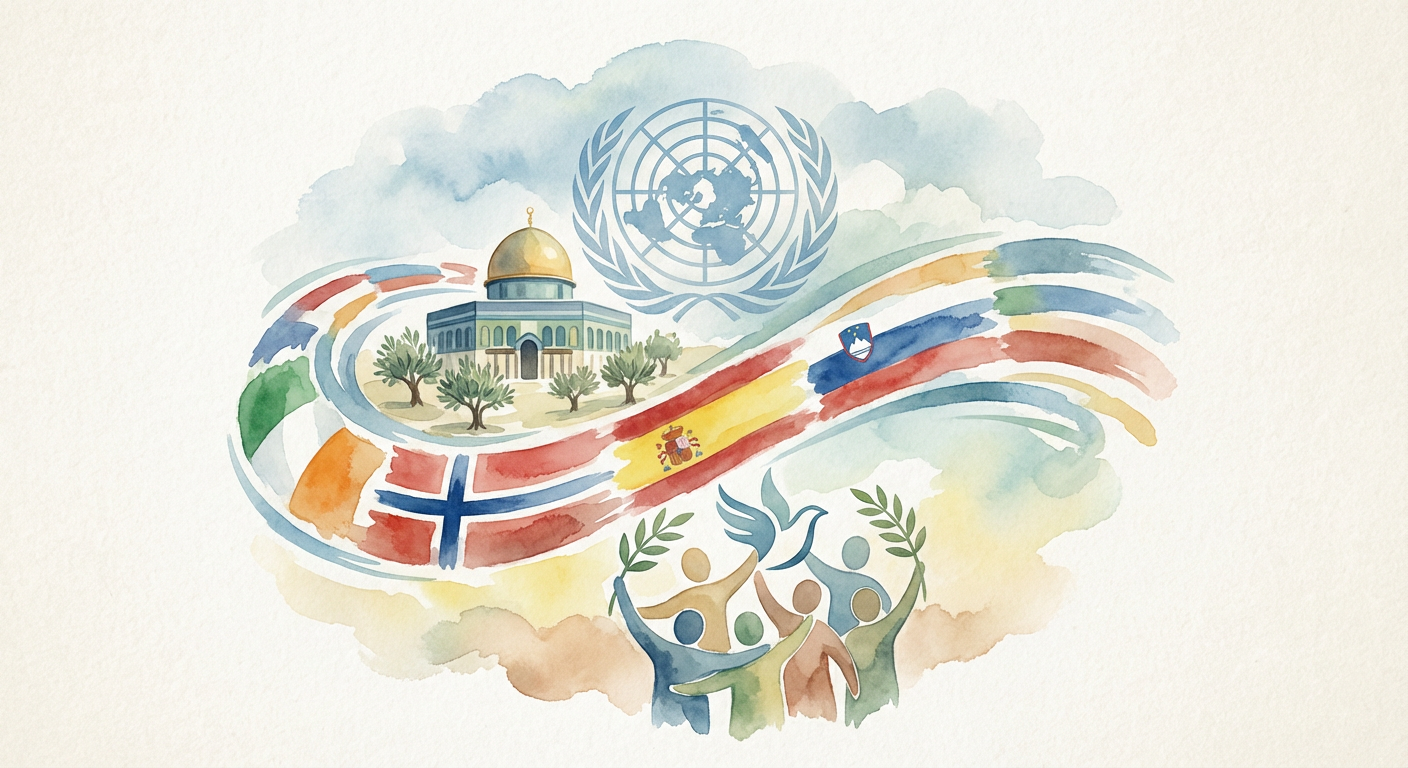
Palestinian statehood recognitions tell a parallel story. As of early 2026, 148 UN member states formally recognize Palestinian statehood. This represents a significant expansion beyond earlier decades. A wave of European recognitions in May 2024, including Ireland, Norway, Spain, and Slovenia, signaled that even traditionally cautious wealthy democracies were reassessing their position. These governments essentially made a statement: we believe Palestinian statehood should exist as a matter of international law and diplomatic fact.
Yet statehood recognition without enforcement mechanisms or material support produces limited practical outcomes. Palestinian state capacity remains constrained by occupation, fragmentation, and dependence on international funding. The formal legal status that recognitions confer does not translate automatically into territorial control, institutional development, or economic viability. Statehood recognition became another form of symbolic commitment, important for diplomatic legitimacy but insufficient for generating substantive change.
The Genocide Question and the Limits of Judicial Language
Perhaps most revealing was the controversy surrounding genocide characterizations. When UN Special Rapporteur Francesca Albanese submitted her report to the Human Rights Council in March 2025, she formally used the term genocide in reference to Gaza. This was not casual language. It was a deliberate legal characterization carrying specific implications under the Genocide Convention. Within weeks, 34 governments cited this assessment in diplomatic statements, suggesting broad recognition that the term applied.
Yet Israel and the United States rejected this characterization entirely. The disagreement was not technical or marginal. It represented a fundamental dispute about what was happening and what it should be called. Crucially, the dispute did not resolve through appeal to agreed legal standards or interpretive authority. Instead, it reflected raw geopolitical division. The same evidence that prompted Albanese and supporting governments to use genocide was interpreted differently by opposing states.
This suggests that international law’s deepest crisis may not be enforcement but legitimacy itself. When different state actors interpret the same facts according to fundamentally different legal principles, the law loses its capacity to adjudicate truth. It becomes one voice among many competing claims, stripped of special authority. International law works precisely because states generally agreed on what it means and accepted its interpretation. When that consensus fractures, so does the system.
What Remains of International Law’s Authority
The aftermath of the ICJ advisory opinion reveals uncomfortable truths about how international law actually functions. It operates through state consent, and powerful states retain disproportionate capacity to withdraw that consent selectively. Judicial pronouncements matter when they align with state interests and carry limited weight when they conflict. Enforcement mechanisms prove illusory when powerful states choose not to enforce them.
This is not an argument that international law is worthless or should be abandoned. It’s a recognition that international law is more constrained than its rhetoric suggests. It functions best as a framework for states that generally want to cooperate, providing them with mutually acceptable terms for doing so. It proves far less effective when states are genuinely in conflict and lack shared interest in peaceful resolution. In Gaza, we witnessed international law tested at the precise moment when its constraints mattered most. The law performed as designed. States simply chose not to follow it.
The question for you, reading this in early 2026, is whether this diagnosis changes how you understand international institutions and their capacity to shape outcomes. What role should advisory opinions play if compliance remains voluntary? Should we reform enforcement mechanisms, or does doing so require political will we demonstrably lack? These are not rhetorical questions. They matter for how we evaluate the Gaza situation and countless other crises where international law intersects with power politics.